

There’s something I noticed a long time ago. I call it the Counterfactualising Curse. Once I explain it, you’ll see it in traders everywhere too.
Counterfactual thinking is our tendency to imagine hypothetical alternatives to what actually happened.
A downward counterfactual is “things could have been worse for me if…” And an upward counterfactual is “things could have been better for me if…”
The upward ones are what traders are hooked on.
How many times have you heard someone say something like, “I was thinking about buying bitcoin back in 2013, I would be a multi-millionaire now.”
Before that, the cliche one used to be about Amazon stock. “My dad almost bought it back in 455 BC!”
People always want to tell everyone about it too.
Robert Cialdini’s research in the 70s called this “basking in reflected glory” (BIRG). By associating yourself with a success, even one you had nothing to do with, you get a little hit of enhanced self-image.
If you’re not making money from your trading and don’t want to feel like a failure, it’s no wonder you’d go for that type of psychological trick.
The problem is, it also creates a delusion that stops you recognising your actual flaws.
If you look on social media, you’ll find countless traders saying, “I’m good at picking the long-term direction of the market, I’m just losing because my timing isn’t good.”
I get emails saying that all the time. You might even believe it about your own trading.
Here’s what I’d say to that.
No sh*t.
You could flip a coin at the start of every month to guess whether a market finishes up or down, and you’d be “right” about half the time.
But that isn’t trading.
And even that 50/50 success rate would probably get inflated in your head, because you remember the months you called correctly and forget the ones you didn’t. Classic confirmation bias.
So you overestimate your ability to predict market direction, and completely miss the real work you need to do to actually improve.
In other words, the story you tell yourself to protect your ego becomes the thing stopping you from becoming the trader you think you could be.
As a trader, timing is everything. You can’t pay your bills with what-ifs.
But that doesn’t mean you need to pick the exact start of a new trend and exit precisely at the end. Instead, there are two stages to timing that no one seems to think about.
First, understand that successful trading comes from one thing only, taking opportunities with positive expectancy.
That expectancy isn’t usually just in one precise fleeting moment, instead it’s more like a window of opportunity.
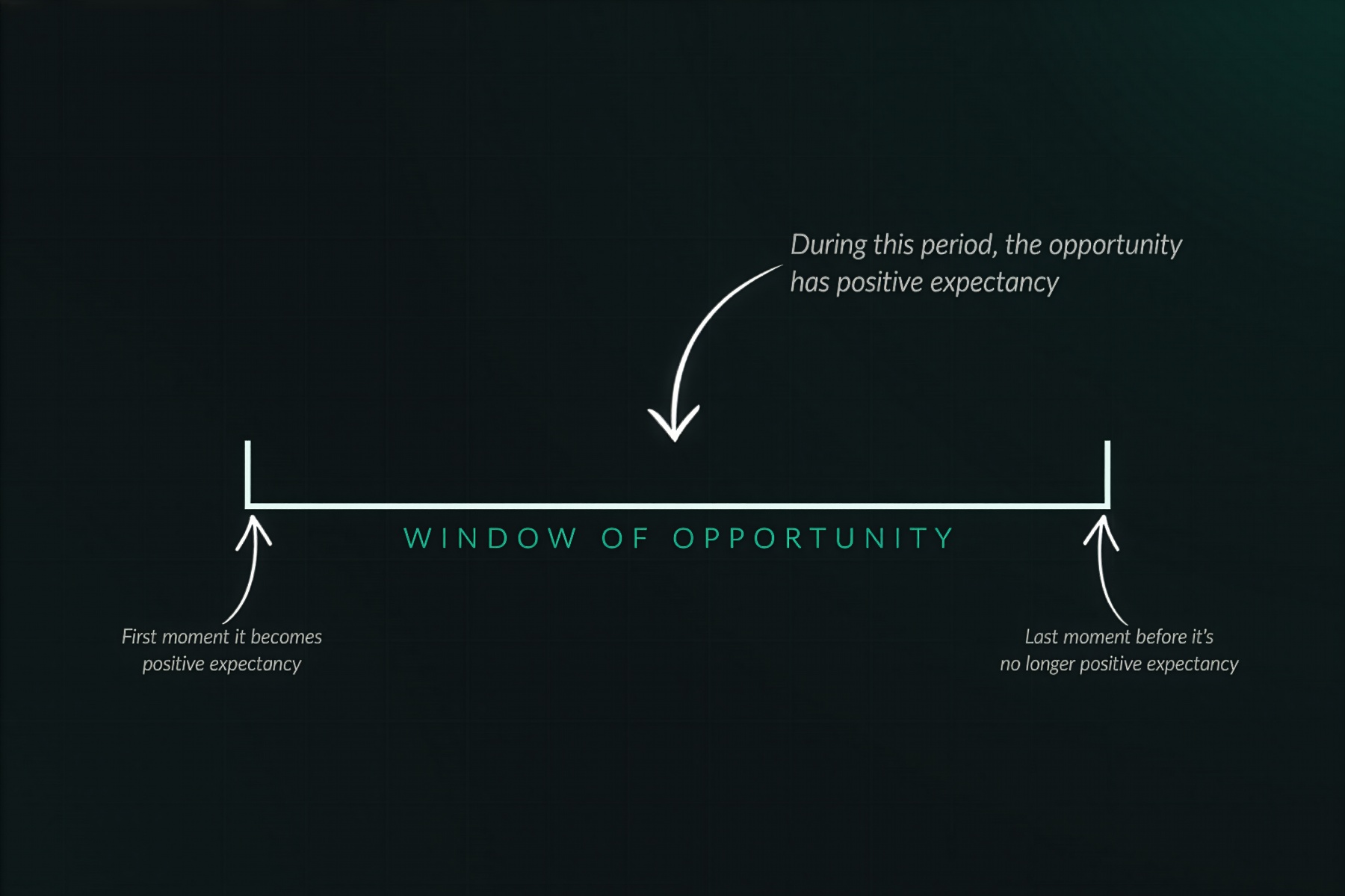
That’s stage one. Enter anytime during that window and you’ll make money over the long run (as long as your actions are logical too).
But this won’t necessarily mean your returns are good.
For great returns, you need stage two.
The expectancy during that window isn’t static. It changes, because the context keeps changing, and that affects the three variables of expectancy: the positive potential outcomes, the negative potential outcomes, and the probabilities of them.
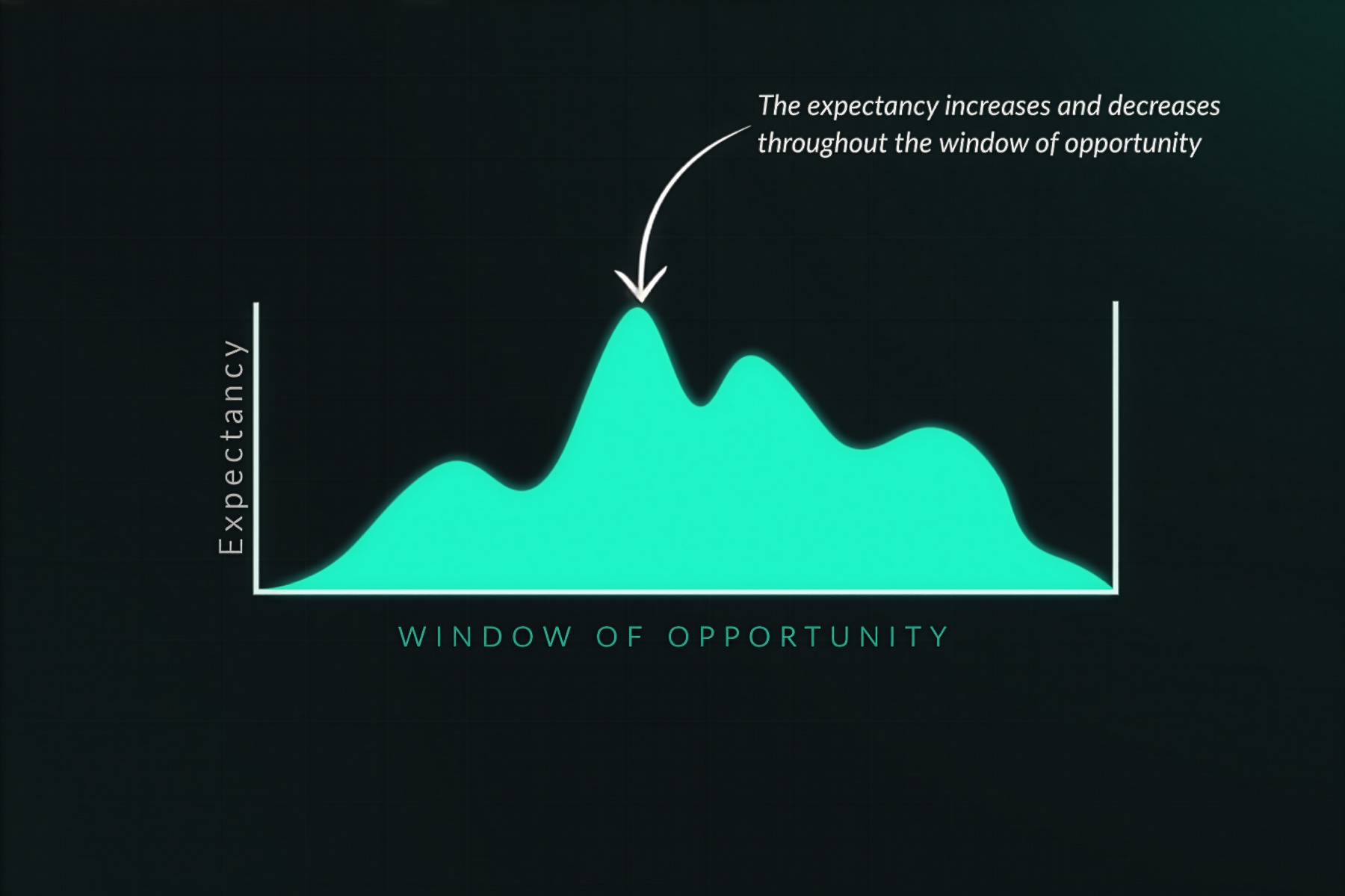
In theory, there’s an optimal point where the expectancy is at its highest.
Your job is to get as close to that peak as you consistently can. Nobody nails it every time. But the closer you get, the better your results.
So no, successful trading doesn’t come from being right about the long-term direction of the market. It comes from:
- Entering when there’s positive expectancy (that’s what allows you to be profitable)
- Getting close to where that expectancy peaks (that’s what determines how profitable)
Most traders aren’t aware of those two factors, let alone actually trying to improve at them. If you start focusing on those areas, you can finally put the Counterfactualising Curse to bed.
Free Training Series
Start the free training.
Get free access to our 5-part training series. It covers the foundations of the Duomo approach, how to analyse markets logically, and the skills serious traders need to develop.