
There are trade opportunities that can be completely valid, have positive expectancy, make you money, and still be bad trades to take.
That sounds odd to a lot of traders at first, because most people still judge opportunities by two crude questions: is it valid, and can it make money? Obviously those things matter. But if you want to trade professionally, they’re not the only things that matter.
Every trade is a resource allocation decision, which means the question is not only whether an opportunity has positive expectancy. The question is whether this opportunity deserves your time, your capital, your focus, and your cognitive energy more than the other things those resources could be used for. If you don’t think about that properly, you can make money and still trade like an amateur, and the result of that is amateurish performance.
A valid opportunity is not automatically a good decision
There’s a big shift that always happens when traders get more experienced, assuming they are actually reviewing their performance properly on a regular basis.
At the start of your trading career, every vaguely tradable situation feels important. You don’t want to miss out on any opportunity; scarcity is doing the thinking for you. So if the opportunity is even marginally positive expectancy, it’s good enough to trade. You end up being over-active in the markets, chasing opportunities all day like a blue-arsed fly.
But over time, if you look back honestly at your trades, you start to notice something. A smaller portion of them usually account for a disproportionate amount of the meaningful returns, while the rest took up time, capital, and attention, without significantly contributing to your performance.
You start to realise that you could have just focused on the smaller percentage of better opportunities, and achieved similar performance while saving yourself a lot of time and effort. And once that dawns on you, that’s exactly the change most successful traders end up making.
Opportunity cost in trading isn’t just about money
When people hear “opportunity cost”, they usually think about the money they might miss by choosing one thing over another. But in trading, there’s much more to it than that.
When you open a trade, you’re not only risking capital. You’re also committing time, attention, and mental energy. We can think of all of these as costs.
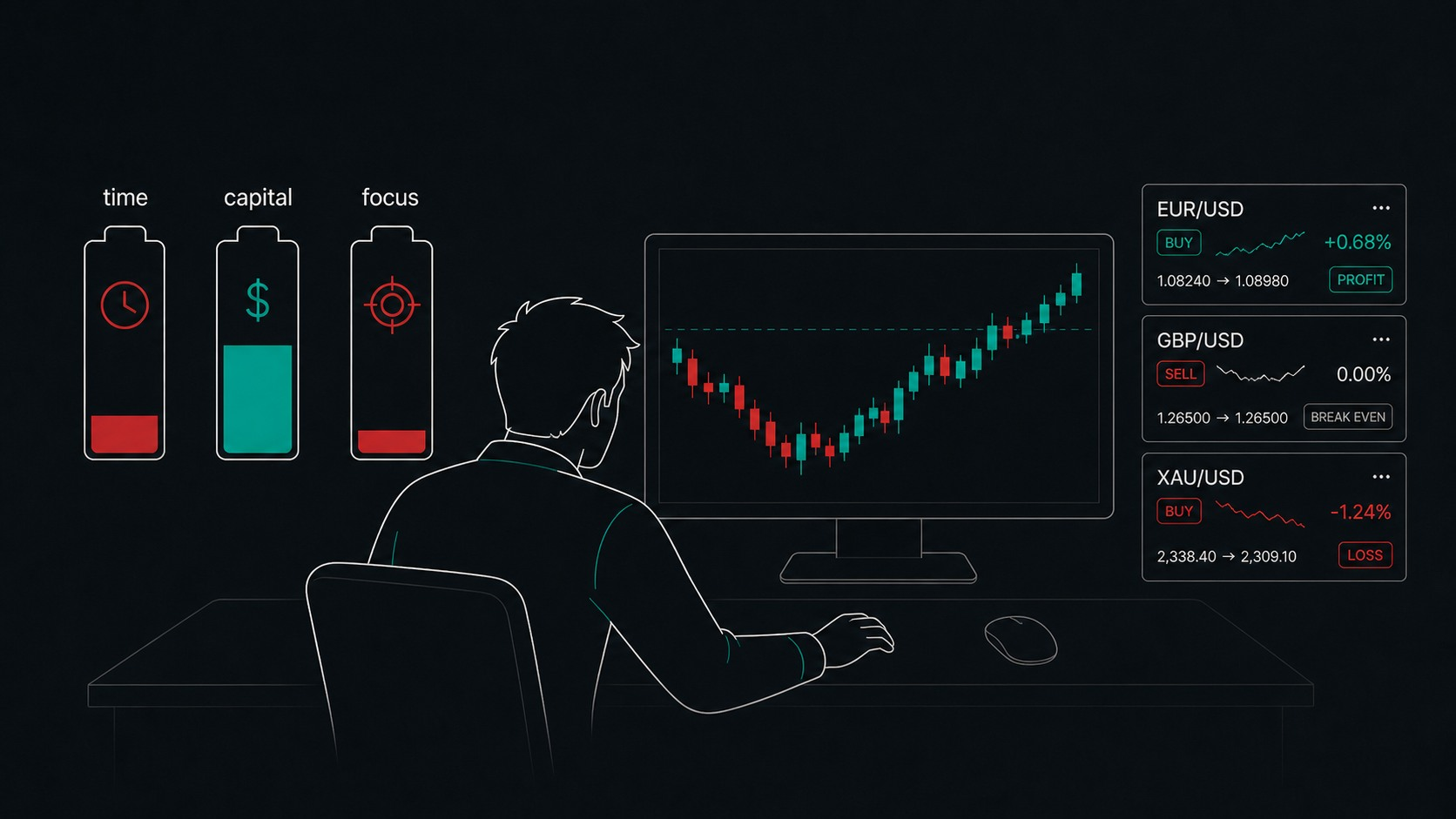
The first is time. This is such a basic question, but most traders never ask it: am I actually being paid well enough for this?
In a normal job, you exchange time or expertise for money. In trading, you are doing that while also risking your own capital. So if a trade produces a poor return relative to the amount of time it takes, that’s not a great exchange. That same time could have gone into a better opportunity or into something else entirely. Something that pays the same or better, without also having your capital at risk.
Then, of course, there’s capital. If your money is tied up in one position, it’s not available elsewhere. So every open trade makes an implicit statement: this is the best use of that capital right now, based on the markets I follow and the context I have analysed. If that wasn’t the case, it wouldn’t be rational to tie up your capital there. Yet, many traders constantly make that implicit statement without actually believing it’s true, or even thinking about it.
That doesn’t mean you need psychic powers or some impossible knowledge of every market on earth. It means you should have enough of a market selection process that you are not blindly locking money into mediocre opportunities while better ones are likely to be out there.
Then there’s mental energy, which people massively underestimate. Even when there’s nothing active to do on a trade, it still lives in your head rent-free. It takes up your focus and makes it harder to do other things, something many traders realise when they try to work their day job while having a position open.
Beyond that, the actual work of analysis, forecasting, planning, and decision-making burns cognitive energy. If you spend too much of that early in the session on poor opportunities, then when a genuinely strong one appears later, you’re approaching it with reduced capability.
That happens all the time. People miss obvious information, overreact to minor fluctuations, and make poor decisions. And it’s not always because the later opportunity was more complex, it’s because they already depleted their mental energy on pointless rubbish earlier in the day.
So the real question is not only whether an opportunity is valid. It’s whether it justifies the cost.
The simple framework I use
I think about opportunities across two simple scales.
The first is expectancy, from lower to higher. And obviously I am only talking about positive expectancy here, because if the expectancy is negative or around the base rate, it is not an opportunity in the first place.
The second is the estimated potential holding period, which means how long I expect the trade to be open in order to realise the opportunity based on the current context and what is likely to develop from it.
Once you think about opportunities through those two dimensions, you can imagine four broad categories.
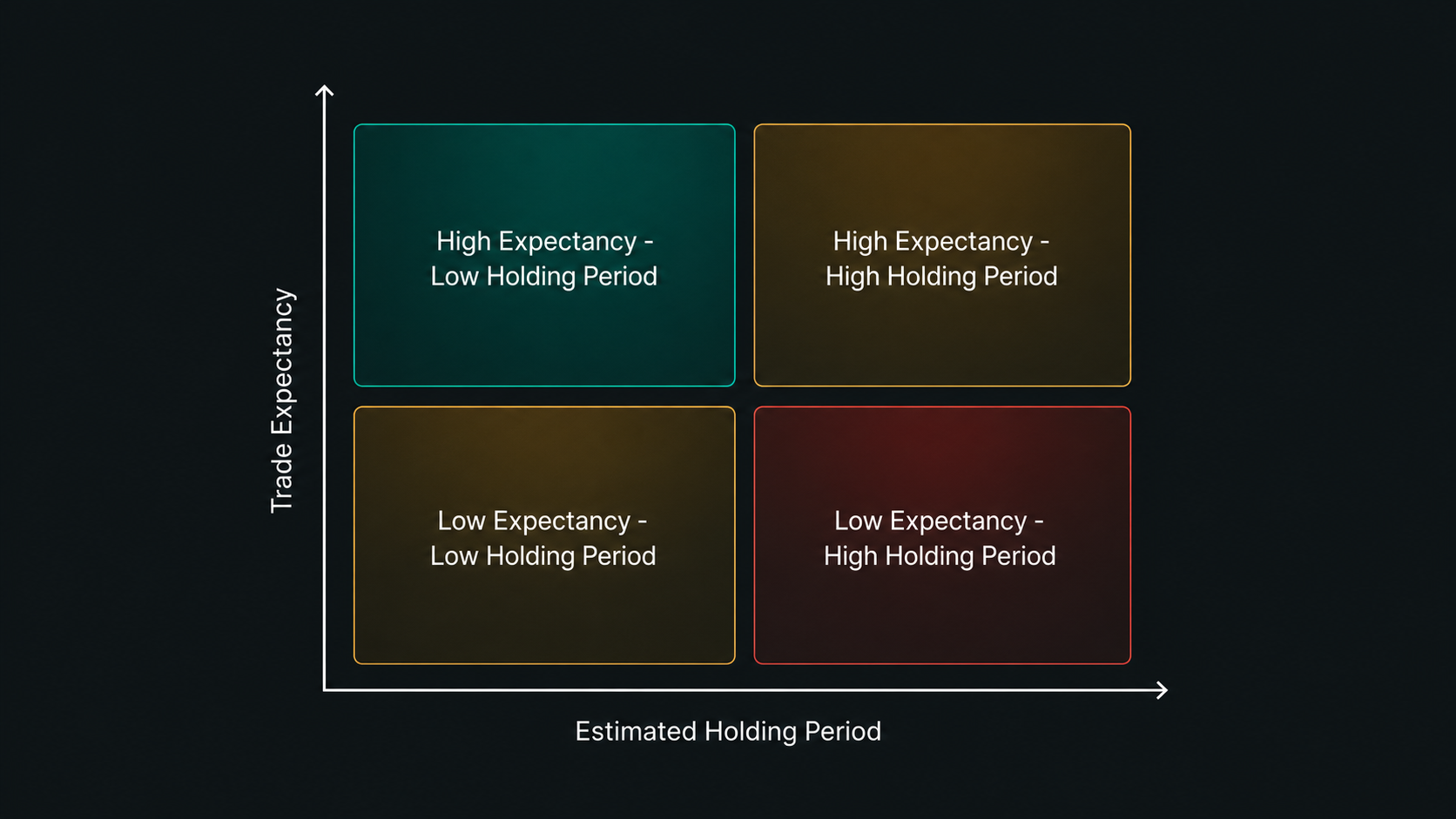
High Expectancy - Low Holding Period
This is the best category. These opportunities are like gold dust.
For me, these are often situations where the market is likely to move quickly once the shift in activity at a dominant significant level resolves one way or the other. Either a momentum breakout or a strong reversal to begin a new trend. It’s a situation where the opportunity is not only good, but the distribution of outcomes is more heavily weighted towards a direct, momentum move.
High Expectancy - High Holding Period
These are still good opportunities, they’re just more resource-heavy. Maybe the higher-order outcomes are still attractive, but the move is more likely to develop gradually through structure over time rather than through a quick momentum shift. So the opportunity can still be excellent, but it costs more in time, tied-up capital, and attention.
Low Expectancy - Low Holding Period
I actually like these quite a lot when they’re assessed properly. They are often more straightforward, there is less management involved, and they can provide solid baseline returns because they are in and out. Range trades can fit here nicely when the surrounding context supports them. They’re not the spectacular runaway trades everyone gets excited about, but they can still be an efficient use of resources. The expectancy is proportionate to the holding period, but the opportunity cost is low.
Low Expectancy - High Holding Period
These are the opportunities you should avoid like the plague. But, unfortunately, they’re the ones most traders spend most of their time focused on. There are more of these types of opportunity than there are in the other categories combined.
They move slowly. They tie up capital. They take up your attention for hours or days. They require patience, focus, and trade management decisions without providing high enough expectancy to be worthwhile. And because they are slow and mediocre, they often drag behaviour down with them. People get bored. They start forcing things. They manage too aggressively because they’re sick of waiting. Or they become too reactive to every minor fluctuation and start making decisions that the original opportunity never justified.
This also shapes market selection
Thinking about opportunities this way doesn’t just affect whether I take a trade or not. It also affects the markets I spend time focusing on in the first place, which means it impacts my market selection process.
Most traders follow too many markets at the start of their career. It’s them being driven by scarcity, chasing too many setups, and thinking more analysis automatically means more opportunity. It usually just means more energy burned on low-quality situations.
Later, once you start to see what genuinely contributes to your results, you ask much better questions. Which contexts actually give me the most bang for my buck? Which markets repeatedly produce opportunities that justify my time and attention? Which trades tied up resources for ages and gave me very little back? Which conditions made me perform better, and which ones wore me down?
That’s how your market selection process starts becoming more professional. You figure out ways of filtering markets more efficiently to avoid the red category situations, and focus more on the green or amber ones.
A practical exercise to investigate your own opportunities
If you want to start making this useful in your own trading, there’s a simple exercise you can do.
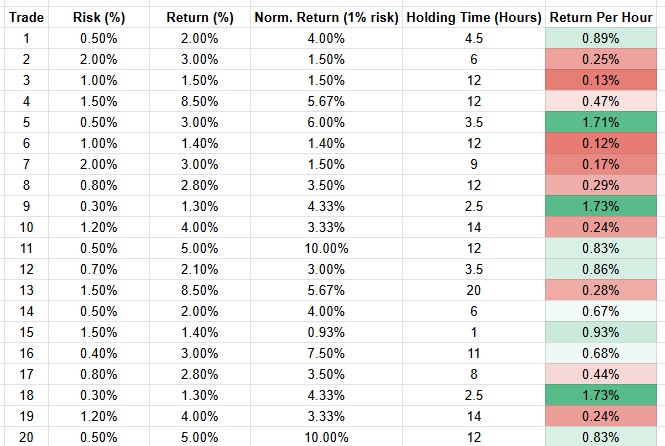
Step 1
Take all of your profitable trades and put them into a spreadsheet. Only profitable trades for now, because if you mix in losing trades while looking specifically at holding period, the data gets distorted very quickly. A losing trade that stops out in two hours and a profitable trade that takes two weeks to fully realise are not giving you the same information about the real opportunity cost.
Step 2
Then normalise the returns so they all reflect the same percentage-at-risk. If one trade risked 0.5% and made 2%, normalise it as if it risked 1%, so the return becomes 4%. If another risked 2% and made 3%, normalise that to 1% risk so the return becomes 1.5%. That way, you are comparing like with like.
Step 3
Then add the holding time for each trade. For most people, hours will make sense as the unit of measure. If you trade much shorter-term or much longer-term, you can adjust that to something more appropriate.
Step 4
Then divide the normalised return by the holding time. That gives you a simple return-per-hour.
It’s really important that you only look at these numbers as being the starting point for a deeper investigation. Don’t look at this as being the conclusion and start adjusting your trading approach based on these calculations. It’s only a starting point.
From there, start categorising the trades by the factors that actually matter in your own trading. Opportunity type. Market type. Session. Time of day. Context category. Whatever is relevant to how you assess opportunities.
Then start looking for patterns. Which trades gave you the best outcomes relative to the time they took? Which ones looked fine at the time but, in hindsight, were an inefficient use of resources? Which contextual features keep showing up in the more efficient opportunities?
There are some caveats, obviously. First, you need a proper sample size or the conclusions will be nonsense. Second, this is looking mainly at time efficiency, not the full picture of opportunity quality. Third, a trade with a lower return per hour is not automatically a bad trade. A large profitable trade held over a long period can still be an excellent use of resources if it delivered something meaningful without needing you to go and find ten other trades during that same time.
So do not turn this into some brain-dead ranking exercise. Use it as a starting point for thinking.
The shift traders need to make
When I first became a full-time trader, I took loads of trades. I barely slept because I didn’t want to miss even the tiniest opportunity. I was glued to the screens all the time. And I sacrificed far too much because of that.
Over time, I learned the lesson. Now I probably open fewer trades than I ever have, because I understand much better what is actually worth my time, energy, and capital. And the opportunities I do focus on get a better version of me, because I’m not spending half the session burning myself out on second-rate situations.
That is a better way to trade.
Amateurs think in terms of scarcity. Professionals think much more in terms of allocation. Not every valid opportunity deserves your resources.
If you want to go deeper into how to analyse context properly, assess opportunities more accurately, and build the actual skill behind these decisions instead of just following fixed setups and hoping for the best, go through my free training series. We’ll go through my logical trading approach in-depth, so you can learn what you really need to succeed at trading over the long-term in a dependable, professional way.
Free Training Series
Start the free training.
Get free access to our 5-part training series. It covers the foundations of the Duomo approach, how to analyse markets logically, and the skills serious traders need to develop.