
In this post
- Trade of the week: WTI Long
- The Problem With Overcrowded Trades
- Quote of the Week: The Wisdom of the Crowd
- Explain Your Trading Thoughts Out Loud
Trade of the Week
There were plenty of big opportunities this week, with prices hitting major significant levels and fading some of the high momentum moves from the week before.
My favourite was this long opportunity on WTI oil. Partly because I had the most vivid dream the night before about taking a huge long position on oil, only to wake up and find a major setup waiting. But beyond that, it was a beautifully clean setup, with a triple confirmation at a key inflection point for the market context. So far, it’s led to a 5% price move, and there were several ways to catch tighter opportunities on the lower time frames too.
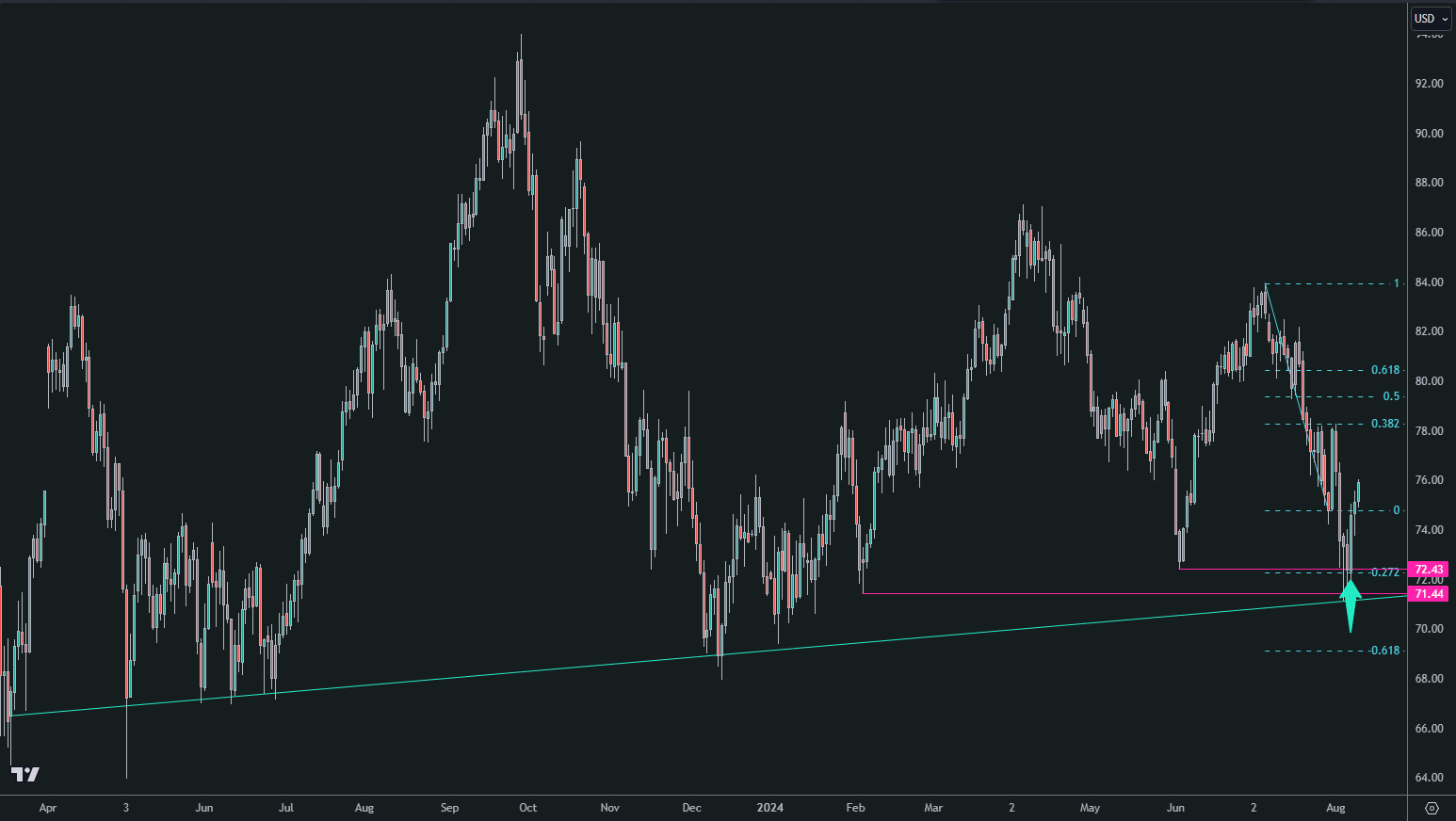
As for the dream, I believe it was a coincidence, but I’ve met many traders who would say otherwise. I’ve had long conversations with Andy Krieger about this in the past. He believes he’s had uncanny premonitions in his dreams and has heard similar stories from other big name traders. I’m not fully on board with that theory… yet!
If you want to start finding trades like this for yourself, check out the Duomo Trader Development Program.
The Problem With Overcrowded Trades
This is particularly relevant for recent events in the markets.
You may have heard people refer to a particular opportunity as being an ‘overcrowded trade’. This is when too many people try to take advantage of the same opportunity and it can cause major issues down the line.
We recently saw this with the yen carry trade, and a number of times in recent years in things like crypto and the VIX. Not to mention some of the major crashes everyone’s aware of from past decades.
Blake LaBaron, an economist at Brandeis University, studied this by creating a computer model with a thousand investors. He gave them money, rules for investing, and different strategies. Then he let the computer run to see what would happen. His model showed patterns similar to real markets, like booms and crashes.
One key finding was that asset prices can keep rising even when everyone is using similar strategies, but this creates a hidden risk. Eventually, the price crashes when more diverse strategies come into play.
He says, “During the run-up to a crash, population diversity falls. Agents begin using very similar trading strategies as their common good performance is reinforced. This makes the population very brittle, in that a small reduction in the demand for shares could have a strong destabilizing impact on the market.”
This relates to the synchrony effect which makes up part of the Duomo Market Theory, and the Fractal Market Hypothesis. Both are explained in our Trader Development Program.
If you’re interested in becoming a member, check out the Duomo Trader Development Program to find out more and apply.
Quote of the Week
“Markets sometimes display an astonishing ability to locate information about recent events and extract its implications for underlying stock values. For example, in the wake of the space shuttle Challenger explosion at 11:39 a.m. EST on January 28, 1986, the stock market very quickly determined which of the four potential contracting manufacturers was at fault for the defective parts of the shuttle: within fifteen minutes, there was a sell-induced New-York Stock Exchange (NYSE) trading halt in the shares of only one company, Morton-Thiokol. By the end of the day its shares had fallen by 11.86 percent, while Lockheed, Martin-Marietta, and Rockwell fell by much less (Maloney and Muhlerin, 2003). By contrast, the general public did not learn of the cause of the crash until two weeks later, on February 11, when Nobel-winning physicist Richard Feynman demonstrated that there were problems with Morton-Thiokol’s booster rockets. This episode illustrates the market’s ability to create knowledge out of a multitude of individual trades, each of which manages to contribute a small piece of information to the overall picture. In this sense, “securities markets are a vehicle for amalgamating unorganized knowledge” (Maloney and Muhlerin, 2003).”
— Excerpt from Market Liquidity: Theory, Evidence, and Policy by Thierry Foucault, Marco Pagano, and Ailsa Roell
My two cents:
I’ve read about this situation a number of times and it’s always fascinating to me. It shows just how powerful the wisdom of the crowd can be. But there’s an important lesson here for traders.
When you make decisions based on fundamental analysis (partially or fully) you have to remember that, most of the time, anything obvious is already priced in. This includes future events, as the markets are forward looking.
Having a view on a current or future situation doesn’t mean it’s an opportunity for a trade. It’s only an opportunity when you figure out the market isn’t currently reflecting that in the price of the asset. Even if it isn’t, you have to consider whether it’s truly the case that you’re right and the market is wrong.
I see many traders making a fundamental mistake when they trade around economic releases. They’ll say things like, “the Fed is going to cut rates at this meeting, so that’ll be bearish for the dollar.” But what if it’s already been bearish for the dollar? If the market is already pricing in a rate cut at a near 100% probability, the expectancy of that opportunity may actually be negative.
Explain Your Trading Thoughts Out Loud
When you’re making a decision with your trading or feeling something about what you’re doing in the markets, explain what you’re thinking or feeling out loud.
This will help you to realise if it fits with your trading plan. It can also help you notice whether a thought is irrational, illogical, or connected with a negative thought pattern that you experience.
Shine a light on how you’re feeling and why you’re doing what you’re doing. For example, “I am looking desperately for a trade now because I just lost my previous trade and want to make it back.”
Free Training Series
Start the free training.
Get free access to our 5-part training series. It covers the foundations of the Duomo approach, how to analyse markets logically, and the skills serious traders need to develop.