
In this post
- Trade of the week: USD/JPY (Short)
- The Negative Spiral of Trading Asymmetric Risk:Reward
- Answering the Wrong Questions About Trade Opportunities
- Quote of the Week: Excel in concentration and focus
Trade of the Week
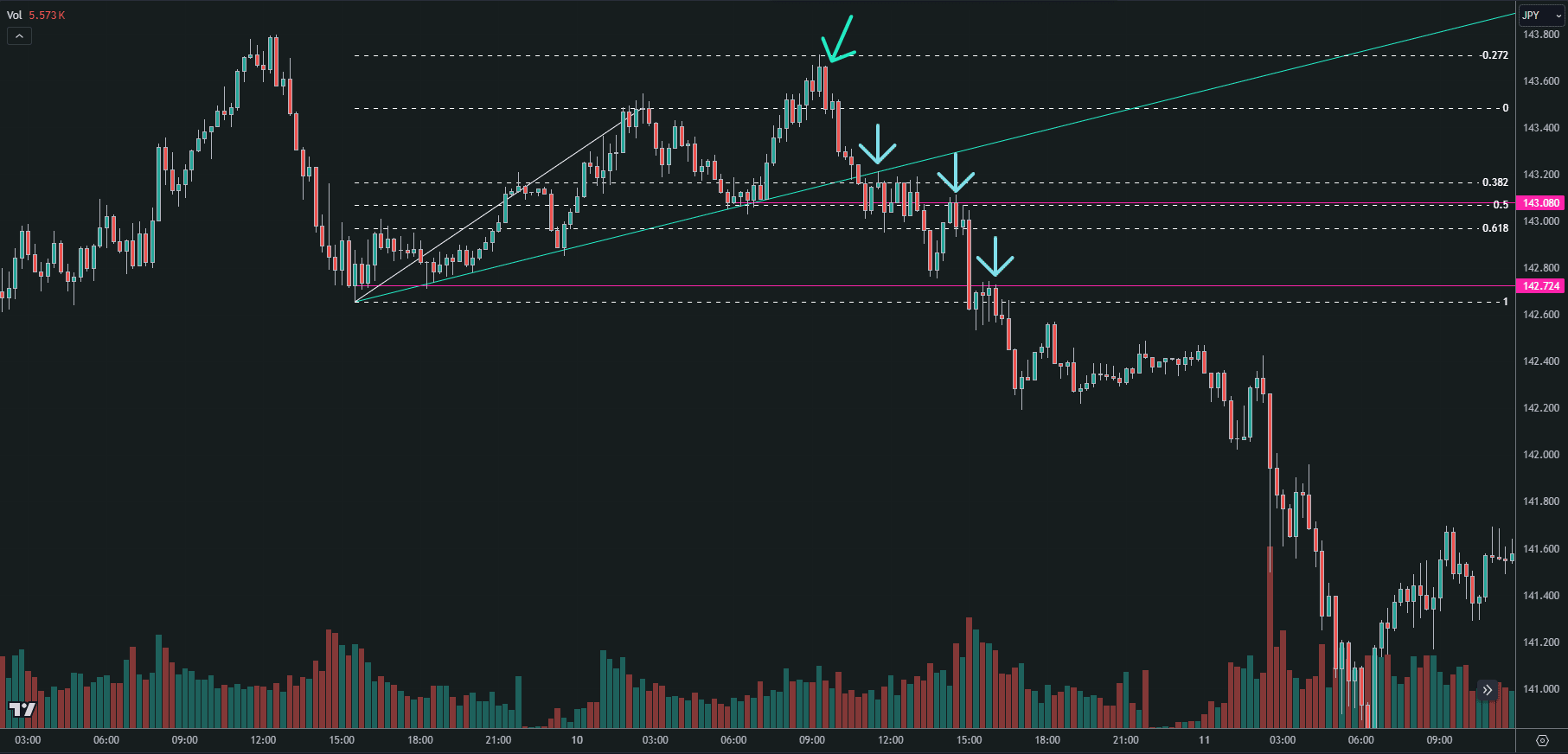
This week we caught an amazing pin-point short entry on USD/JPY that led to a 250+ pip move in less than 24 hours, with an initial ~20 pip stop loss. This is another example of just how precise the Duomo Method can be.
If you’re a Duomo Member, you should read the real-time updates I provided in the Live Chat. It was one of those ‘crystal ball’ days where the price movements were almost exactly what we anticipated to an eery level of detail.
In brief, the dynamics of the market on the higher time frames were suggesting that any bullish pullbacks would be short lived. We were interacting with a strong path of resistance and it was clear the bullish imbalance was weak and starting to be absorbed.
We just needed the right timing to enter a trade, which we found on a 15-minute failure of a 127.2, which had confluence with confirmations on both the 4-hour and 1-hour time frames.
In the screenshot below, you can see the initial entry at the top (on the close of the bullish candle), and subsequent break and retests of key levels. These retests helped to confirm the context, and could have been used as scale-in opportunities (particularly the later two).
One of our members, Daniel, picked up a similar trade on EUR/JPY with a 9% profit. The trade helped him to pass the criteria needed to achieve his funded trading account. So, big congratulations to Daniel!
If you’re not already a member and you want to follow my analysis and learn how to spot precise trades like this for yourself, check out the Duomo Trader Development Program.
The Negative Spiral of Trading Asymmetric Risk:Reward
I often see traders saying things like: “The trade didn’t go to plan,” or, “It seems like every trade I open is a loss!”
When you dig deeper, it’s usually the same story. They’re trading with an asymmetric risk:reward ratio but haven’t fully accepted what that means.
First, let me be clear-most of my trades are asymmetric, so I’m not suggesting that’s a problem. The issue is perception.
When a trade has a favourable asymmetric risk:reward ratio, the potential profit is much larger than the potential loss. But this usually means that losing is the most likely outcome for the individual trade.
For example, if the risk:reward ratio is 1:4 and you have no edge, the probability of a loss is 80%. Assuming you’re taking the trade because you do have an edge, it would have to be the trade of the century to shift the probabilities enough to make a profit more likely than a loss.
It’s a funny feeling to open a trade that you’re expecting to lose. But it’s important that you fully embrace that. The payoff comes over the long term, when the positive expectancy plays out over multiple trades, not in any single trade.
This is what causes traders to fall into a negative spiral. Instead of committing and allowing the positive expectancy to play out over time, they get discouraged by losses and start doubting their strategy. They tweak their system to avoid losses, over-adjust, and make their system inconsistent. Ultimately resulting in a negative Trader’s Equation.
Having the right perspective is key.
Stop Answering the Wrong Questions About Trade Opportunities
One of the biggest challenges in trading is deciding whether an opportunity is worth trading. We’re not naturally well-equipped to make judgements about uncertain future outcomes.
In these moments, we’re essentially asking ourselves questions about various aspects of the market context. The problem is, those questions are difficult to answer.
So, what do we do? As Daniel Kahneman explains, when faced with a complex judgement, we often go through ‘attribute substitution’. We unknowingly substitute the hard question for a related easier one. This is the basis of many common cognitive biases.
For example, figuring out the probability of a reversal at a particular level involves a complex thought process. To make that judgement, you might unconsciously answer, “How clean does my analysis look?” or “What happened last time I traded a reversal?”
Without realising, you’re answering a different question to the one you intended. The conclusion you reach is less likely to be accurate and reliable.
The simple solution is to use a checklist that forces you to evaluate each aspect of the opportunity correctly.
If you’re already estimating probabilities in your trading, a useful approach is to include a table in your trading journal with the key components already listed. As you assess an opportunity, note the individual probability adjustments for each component. This forces you to carefully consider all the variables, helping you answer the harder question without falling into the trap of substitution.
Quote of the Week
“During the speculating day, I am frequently distracted with divertissements that tend to make me let down. To minimize them, I don’t take phone calls, break for lunch, or allow visitors.
I think of a great baseball player of my youth, Ted Williams. When he found that the fuss about his August birthday was distracting him unduly from batting .400 plus, he simply changed the date of his birthday to October. I do not have the natural flair or wisdom of some traders, or the research skills of others, but I excel in concentration and focus.”
— Victor Niederhoffer
Your greatest asset in the markets is your mind. The more focused you are, the better you’ll perform, and the faster you’ll improve. We live in a world filled with distractions, especially in the online trading space. I see so many traders falling for ‘shiny-object syndrome’ and wasting time on different tools and improvements from one week to the next that don’t add real value.
It’s easy to get pulled away from what really matters. The key is simple: always keep the main thing the main thing. Viciously protect your trading time, avoid unnecessary interruptions, and maintain focus. Discipline is what separates good traders from great ones.
Free Training Series
Start the free training.
Get free access to our 5-part training series. It covers the foundations of the Duomo approach, how to analyse markets logically, and the skills serious traders need to develop.