
In this post
- Trade of the week: Copper (Long)
- The Importance of Volume and Context for Trading
- Quote of the Week: Fear and evolution
- How to Avoid Making Trading Mistakes
Trade of the Week
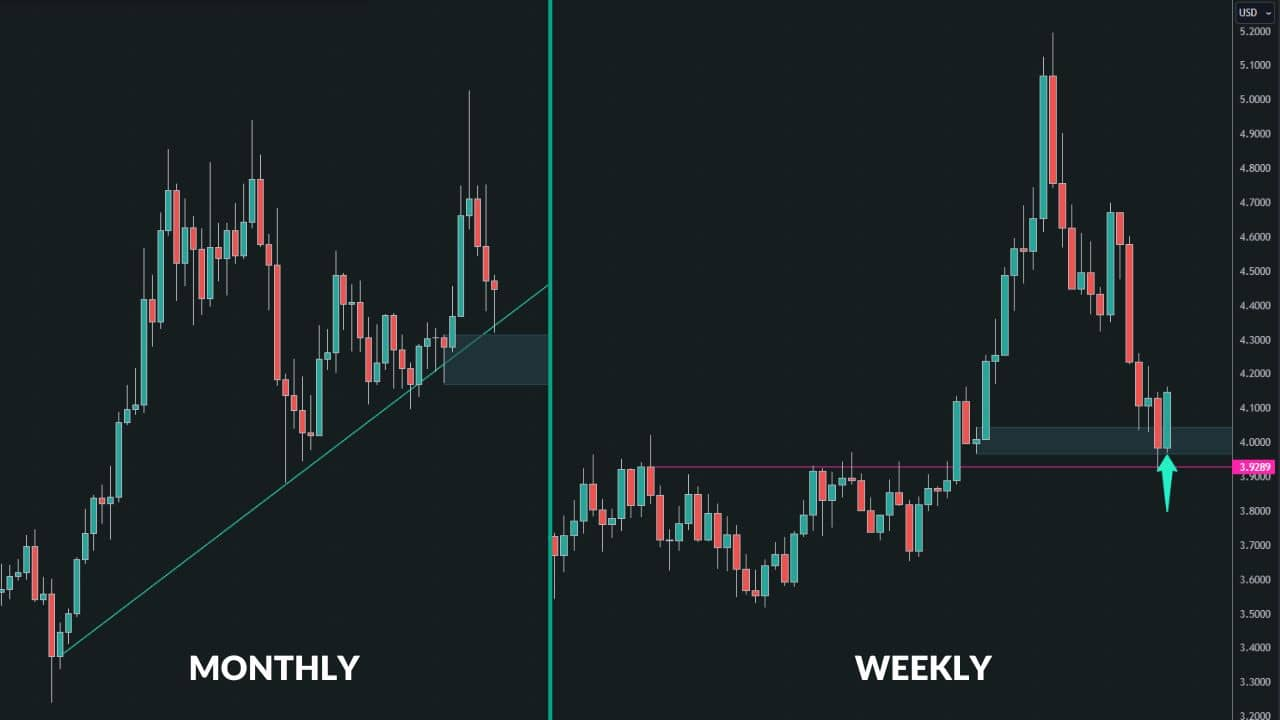
Our Trade of the Week wasn’t one I personally took (it was far too early in the morning), and it wasn’t the biggest opportunity out there. Instead, I chose this trade because it emerged from a group analysis session during our Weekly Member Live Room on Friday 9 August.
During the hour-and-a-half session, our group identified a potential terminal point in Copper’s sustained downtrend. Together, we logically analysed the market context and mapped out a series of potential outcomes, along with the signals to watch for as the market developed.
There were three key takeaways for our members from this session:
- A trade opportunity isn’t just about identifying significant levels through technical analysis. What gives them meaning is how they relate to the market context. That’s the critical skill that leads to great trades.
- Taking a logical approach to analysing the context makes it easier to understand previous price movements and what that means for the current price level. This makes it much easier to anticipate future moves, giving you more confidence in the opportunities you trade.
- When you follow this process, you can find opportunities everywhere.
(If you’re a member, I’d recommend watching the replay in the community. It was a fun session!)
The following week, the price movements unfolded exactly as we had anticipated, leading to several potential entry points.
The opportunity in the screenshots below was from the 1-hour time frame. It came once the price had confirmed a shift to bullish structure, reducing the risk of a return to bearish momentum.
Depending on how you structured the trade, it could have achieved a 7R profit (or a 3% move in the price) so far.
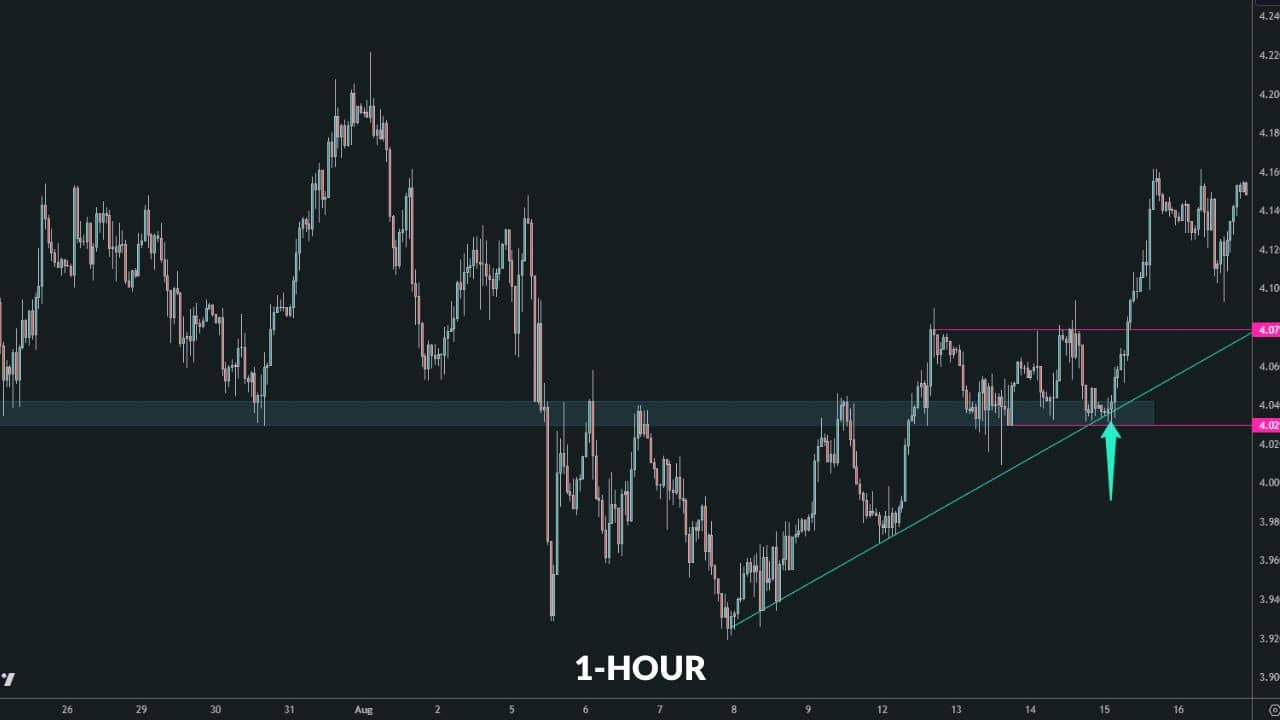
When analysis is done correctly, it’s not just about spotting the right levels-it’s more like a problem-solving exercise. And that’s not only more rewarding financially, but you also get the buzz of those “a-ha” moments.
If you want to start finding trades like this for yourself, check out the Duomo Trader Development Program.
The Importance of Volume and Context for Trading
Imagine you’re at a classic car auction. In the room it’s just you and five other people.
The auctioneer announces the opening price and someone places a bid. The price is raised slightly, and another bid comes in. But at the next price raise, there’s a slight pause. Finally someone bids, but at the next increase, no more bids come in and the auction ends. The price didn’t move much because there wasn’t much interest-activity was low.
The next day you attend a similar auction, but this time the room is packed with hundreds of people. As soon as the auctioneer starts, there’s a frenzy of bidding. Every time the price rises, more bids come in, until after 10 minutes, the activity starts to slow down. Eventually, a price is reached where no more bids are made, and the auction closes. Here, the price moved significantly because of the high level of activity.
In these two scenarios, there’s a direct link between price movement and the volume of activity. When activity is high, prices are justified in going higher. When activity drops off, so does the price movement.
On the other hand, imagine you’re following an online auction. The price rises steadily just like in the second auction, but you can’t see how many people are bidding. For all you know, it could just be the seller placing fake bids to drift the price higher. If you place a bid in this situation, you might end up overpaying for the asset.
The key difference in these situations is visibility. When you can see the level of activity, you can validate whether the price movements are justified. Using volume in your analysis is vital.
However, when we say that volume can validate a price movement, it has to be considered in relation to the broader market context. For example, a small price movement paired with a huge surge in volume might seem like an anomaly. But its significance depends on where and when it happens.
Imagine watching a strongman on TV pulling a truck up a hill. At first, the truck moves smoothly as he builds momentum, but as the hill gets steeper, the truck slows down. Eventually, it nearly stops. You can see the strongman putting in more effort than ever before. His muscles are bulging, veins popping… But the truck barely moves.
What do you think will happen next? He doesn’t have enough force to move the truck further. Soon that force will reduce and the truck will start to roll backwards. As it does, it picks up more momentum, the strongman reduces his effort, and eventually unclips his harness to allow the truck to roll back down the hill.
While not a perfect analogy, it helps make the point. The strongman’s effort represents activity or volume. When the effort leads to movement, it validates the action. But if the truck stops moving despite increased effort, it suggests something is off. The resistance in the other direction is stronger.
Let’s bring this back to the markets. Volume and price movements aren’t so meaningful in isolation; the context is also important. For example, let’s say we have a high momentum move. The price reaches a significant level and volume increases, but the price doesn’t push further. This indicates a shift in activity. The buying pressure is being absorbed, signalling a path of resistance and a possible reversal.
It comes back to the relationship between supply, demand and price. If activity increases but the price no longer moves as it was before, it could indicate that there’s a lot more supply than before.
If we just rely on price, we’ll miss the level of activity. If we don’t include context, we might misinterpret the situation.
Quote of the Week
“While our fear reflexes may protect us from injury, they do little to prevent us from losing large sums of money. Psychologists and behavioral economists agree that sustained emotional stress impairs our ability to make rational decisions. Fear leads us to double down on our mistakes rather than cutting our losses, to sell at the bottom and buy back at the top, and to fall into many other well-known traps that have confounded most small investors-and not a few financial professionals. Our fear makes us vulnerable in the marketplace.
Financial behavior that may seem irrational now is really behavior that hasn’t had sufficient time to adapt to modern contexts. An obvious example from nature is the great white shark, a near-perfect predator that moves through the water with fearsome grace and efficiency, thanks to 400 million years of adaptation. But take that shark out of the water and drop it onto a sandy beach, and its flailing undulations will look silly and irrational. It’s perfectly adapted to the depths of the ocean, not to dry land.
Irrational financial behavior is similar to the shark’s distress: human behavior taken out of its proper evolutionary context. The difference between the irrational investor and the shark on the beach is the shorter length of time the investor has had to adapt to the financial environment, and the much faster speed with which that environment is changing.”
— Andrew Lo
How to Avoid Making Trading Mistakes
In case you missed it, we shared a new video earlier this week on how to avoid common trading mistakes. In the video, I break down why traders often slip up even when they feel they should know better, and offer three practical tips to help you reduce the chances of making these mistakes.
You can watch the video here.
Free Training Series
Start the free training.
Get free access to our 5-part training series. It covers the foundations of the Duomo approach, how to analyse markets logically, and the skills serious traders need to develop.