
Over the years, I’ve had loads of friends ask me to teach them how to trade. These days, I usually just say no, because I’ve had too many bad experiences with it.
Most people love the idea of where they’ll be once they’ve “made it,” but the actual work it takes to get there is a completely different story. And then you have to tell a mate you care about that the only reason they’re getting nowhere with their trading is that they’re being lazy. Some people can handle that sort of honesty, and want to be told directly, but most people just get defensive, and make you wish you’d never said anything at all.
So a few years ago, I worked out a simple technique that gets someone to see, completely on their own, exactly how they’re sabotaging their own work.
Why You Can’t See Your Own Gaps
The reason all of this is so difficult is that we’re genuinely wired to overrate ourselves. There’s a whole load of research on this, and it’s pretty brutal at times.
Most people think they’re more skilled, and more likely to succeed, than they actually are. And it tends to be the least capable people who are the most overconfident of anyone. The psychologists Justin Kruger and David Dunning demonstrated this in their 1999 study. Poor performers overestimated their own percentile ranking by an average of 50 percentage points.
So you end up with a gap between what you think you’re doing and what you’re actually doing. You don’t notice the gap, because the same optimism that’s letting you paper over the cracks is the exact thing you’d need to see past to recognise the difference.
That’s exactly why being told by someone else sometimes just doesn’t register. But a reality check you figure out for yourself hits completely differently.
Why Picturing Success Backfires
Our minds are complex. It’s funny how often our own brains are self-sabotaging without us even noticing, and that’s exactly what happens here.
I’m sure at some point you’ve been given the advice to visualise your success. Picture where you want to be, go through all the details in your mind, get excited about it, hype yourself up, and that will somehow pull you towards that vision and make it a reality.
There’s a version of that which is fine. But on its own, just sitting there fantasising about some dream outcome can actually do the opposite. It can make you less likely to get there.
The psychologist Gabriele Oettingen has spent years researching exactly this. What she found is that the more positively people fantasise about a future they want, the less effort they actually put in, and the less likely they are to get there.
When you vividly imagine already having the thing, your brain gets a little hit of the reward right now, today. So the pressure to go and actually earn it declines. You feel like you’ve already got part of the way there just by visualising it, so you ease off without realising.
That’s why so many people satisfy themselves with the potential they have, rather than actually doing the work that makes the potential a reality. As long as they have the potential, they think they can get where they want one day, and that eases the discomfort of not being there right now.
It’s exactly what so many traders do. They daydream about telling their boss to shove their job because they’re going to be trading full-time. They think about the fancy office, the house, the cars. All that daydreaming just drains the drive you need to actually succeed in the first place.
But Oettingen didn’t stop there, because she also found the fix. If you take that vision of success and deliberately contrast it with everything standing in your way, all the obstacles, all the ways it could go wrong, all the things that could stop you achieving it, that’s when the fantasy actually turns into motivation and action.
She calls it mental contrasting, and that’s the principle behind the technique I’m about to show you.
Reverse Brainstorming
The technique is called reverse brainstorming, and it’s really simple. It’s just five steps, but done properly it works well, so it’s worth spending proper time on it. Here’s how it goes.
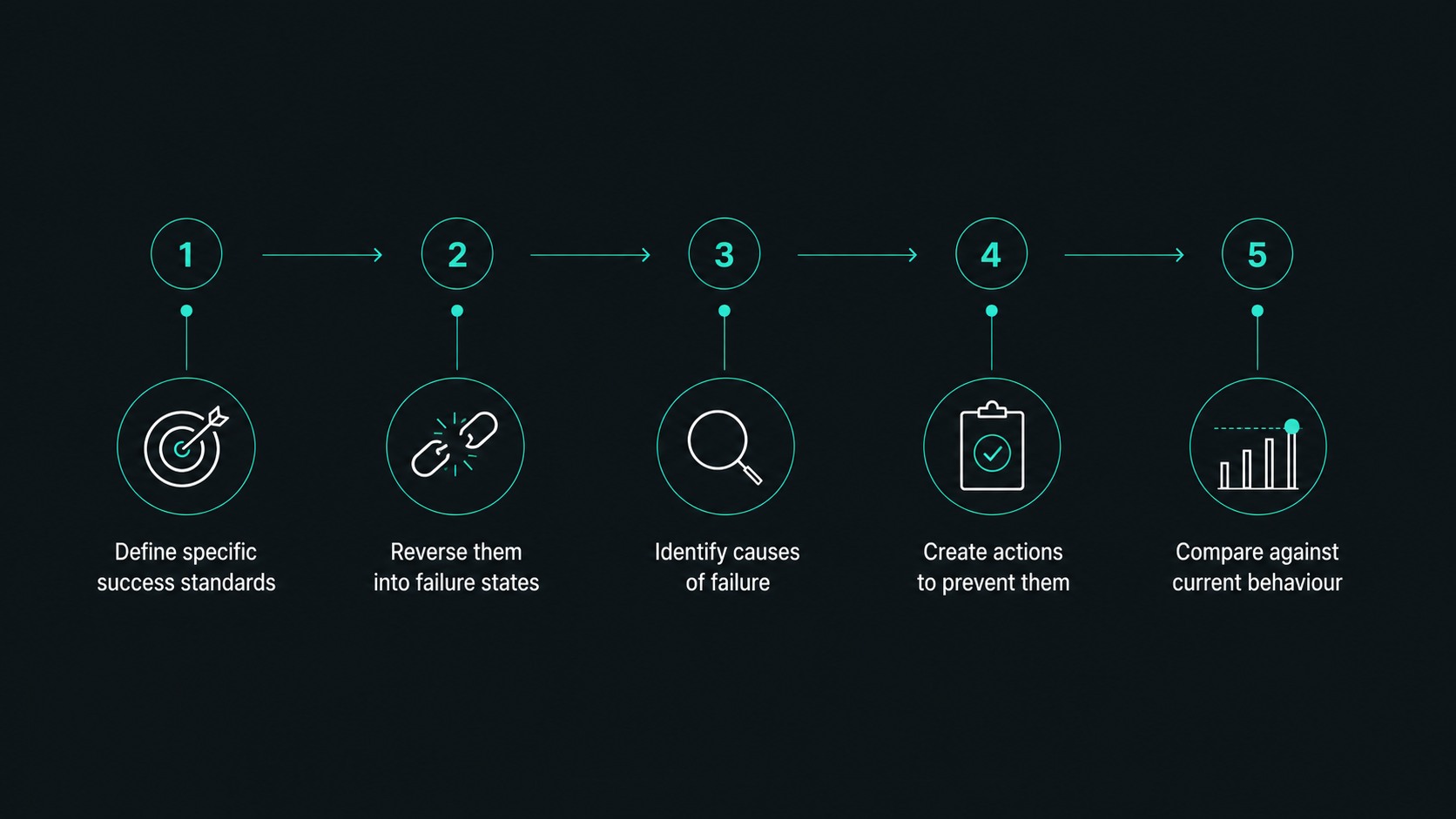
Step one - imagine your success
Imagine you’re trading five years from now, assuming you’ve genuinely succeeded by that point, and brainstorm everything involved in that from a practical point of view. Not the financial rewards, but the actual practical parts. What’s involved in that success?
Don’t be vague about it. Don’t say something like “trading consistently profitably,” because that’s just going to be useless. Get really specific, almost like setting a KPI for every area of your trading.
Go through each aspect of your trading and assign it a success measure, some process or way of approaching things that leads to you being a success in five years.
For example, instead of “good analysis,” something measurable, like your probability estimates being within a couple of percent of what actually happens on average.
Go through every single area of your trading like that. Your analysis, each aspect of your trade management, your routine, your review process, your data analysis, your risk, your development work, everything you can think of, and define what real success actually looks like, as specific as possible.
Make sure all of these are things you can actually control, your actions and your skills, rather than pure outcomes like monthly returns, which are partly out of your control. Set your standards around the stuff that’s genuinely on you.
Step two - flip your success into failure
Flip every single one of these to its complete opposite. Turn each success into a failure.
“Estimates within a couple of percent” becomes “my estimates are all over the place, and I’m basically guessing each time I take a trade.”
Go through them one by one and reverse the whole lot, and again, be as specific as possible.
Step three - find the anti-solutions
Go through each of those failures one by one and spend time brainstorming every possible thing that could have caused it.
If the failure is “I’m basically guessing with my probabilities on each opportunity I take,” what might cause that?
- Never collecting any data on your outcomes.
- Never writing down your probability estimates at the time of taking an opportunity.
- Not estimating probabilities to decide if it’s an opportunity in the first place.
- Changing your trading approach so often that you never build up enough data to actually learn anything.
- Too small a sample size.
- Not going through periodic calibration and optimisation.
These are all what I’d call your anti-solutions, the ways you can basically guarantee failure.
Step four - plan the preventions and solutions
Go through the anti-solutions one by one, and for each cause, work out the specific action you could take to avoid it. The specific thing that stops that failure happening in the first place.
Step five - compare your current reality
This is where the reality check really hits you.
Take the whole map you’ve just put together, the path that leads to failure and the path that avoids it, and compare it against what you’re actually doing right now.
Ask yourself honestly, going through it one by one: are my current actions closer to the path that leads to failure, or the one that avoids it? Where are the gaps? What would I actually have to do if I want to fix them?
There may be areas you’re on track with, but I guarantee there are plenty where you’re not doing what you should be if you want to succeed, or at least if you want to avoid failure, which is basically the same thing.
I know some people will hear all of that and think, “well, that sounds really simple.” But it’s really effective, and I could see that the very first time I ran through it with one of my mates. When he sat down and went through the process, he spotted all of the ways he was cutting corners entirely by himself. I didn’t have to say anything. He just said, “you’re a genius, I know exactly what I need to do now,” when really, he’d just figured it out for himself.
Why This Works: The Premortem Effect
So why does flipping something into a failure work so much better than just planning forwards in a normal, linear way, like everyone else does?
This is actually a technique that’s been around and studied for decades. It’s called a premortem analysis.
You’ve probably heard of a postmortem, where you look back after something’s already died and try to work out what killed it. A premortem flips that around. You imagine the thing has already failed, today, and then explain all the reasons why it happened. It was developed by the researcher Gary Klein, and Daniel Kahneman, who’s about as respected as it gets in decision-making science, has called it one of his favourite tools.
In a study back in 1989, the researchers Deborah Mitchell, J. Edward Russo, and Nancy Pennington found that imagining an event had already happened, and then explaining why, made people roughly 30 percent better at correctly identifying the real reasons behind it. Thirty percent, purely from flipping the direction you’re thinking in.
It works because of how your brain handles optimism. When you’re planning forwards towards a goal, you’re in a hopeful, optimistic frame of mind, and that frame hides the risks from you, because you don’t want to see them. The second you assume it’s already failed, that optimism stops interfering, and all the stuff you were conveniently ignoring becomes a lot more obvious.
It’s the same reason the inversion mental model, working out exactly how you’d guarantee the worst outcome and then simply avoiding those things, is such a well-known way of solving problems.
At Duomo, we always recommend using some form of premortem throughout trading: deciding how to manage an opportunity, how you’re going to approach going for funding, all kinds of things.
Things to Be Cautious About
Two quick warnings, so you don’t misuse this.
First, that five-year vision from step one is just there to give you direction and to run the diagnosis. It isn’t meant to be the stick you beat yourself with every day.
There’s a psychological concept called the zone of proximal development, the gap between what you can already do and what’s realistically within reach if you’re stretched properly. If you fixate on a massive five-year goal while you’re right near the start of your journey, and that gap feels too big, your motivation just ends up getting crushed.
The real output of this exercise isn’t the dream. It’s the short-term changes it shows you that you need to make. Your day-to-day action plan should focus on those changes, not the gap between where you are now and where you need to get to.
Second, don’t let this exercise become a form of procrastination in itself. It’s weirdly satisfying to sit and plan things out. It feels productive, but planning isn’t the same as doing. Run the exercise, take time to do it properly, but then find the gaps, make your plan, and focus all of your time on taking the actions to fix those things.
The entire point is to change what you do from tomorrow onwards, not to give you some sort of manifestation document to sit there and daydream with. There’s no point in that. You might as well be focusing on the actions you need to take.
If you’re not sure exactly what you need to develop, or how to develop it in the right way once you’ve found the gaps, that’s what my free training series is for. It explains my logical approach to trading, built from almost 25 years of doing this, and the real skills you need to start learning if you want to succeed in the markets.
But regardless of the actual action plan you end up with, the real value of this exercise, and the reason I recommend it to everyone, is what it does to your perspective, and therefore to your behaviour. It’s a bit like when Scrooge is visited by the Ghost of Christmas Past. Once you can clearly see where your current behaviour is taking you, you stop wanting to carry on the way you’re going.
And that future version of you is real, both the success and the failure. Every single thing you do, every action, every decision, every way you approach things each and every day, is either an investment you’re making into the right outcome, or a debt you’re going to end up paying.
Right now, most traders are running up a serious debt and telling themselves they’re on track and things are going to be fine. This technique drags that debt out and puts it right in front of your face, while you’ve still got time to do something about it.
Free Training Series
Start the free training.
Get free access to our 5-part training series. It covers the foundations of the Duomo approach, how to analyse markets logically, and the skills serious traders need to develop.