
In this post
- Trade of the week: EUR/CHF (Short)
- How to Gain Trading Experience Quicker
- Quote of the Week: Dealing With Complexity In Analysis
- Without a Trading Plan, the Markets Will Feel Manic
- The Trading Life Is Tough, But You’re Not Alone (Video)
Trade of the Week
With the US election and central bank activity last week, the trading environment was always going to be tricky.
There were two criteria for this week’s trade of the week:
- The trade needed to take place after the election outcome was confirmed.
- The market had to be one that’s less affected by US election results or the Federal Reserve’s monetary policy decision.
The market was EUR/CHF. On the higher time frames, the market appeared to be in a value area.
On the 1-hour chart (screenshot below), we saw a dependable range, only temporarily disrupted by election activity. This was also within a larger range that can be seen best on the 4-hour chart.
After the election, the range was respected again, with price testing the top.
We were expecting responsive action. Momentum had slowed, and there were signs we’d hit an area of liquidity.
To time the ideal trade entry, we had a triple confirmation: a Type 1 close at the extreme high, and Type 3s on the lower high and 161.8 from a perfectly confirmed range.
The stop loss was above the highs, which was 15 pips. The bottom of the range came in at around 40 pips.
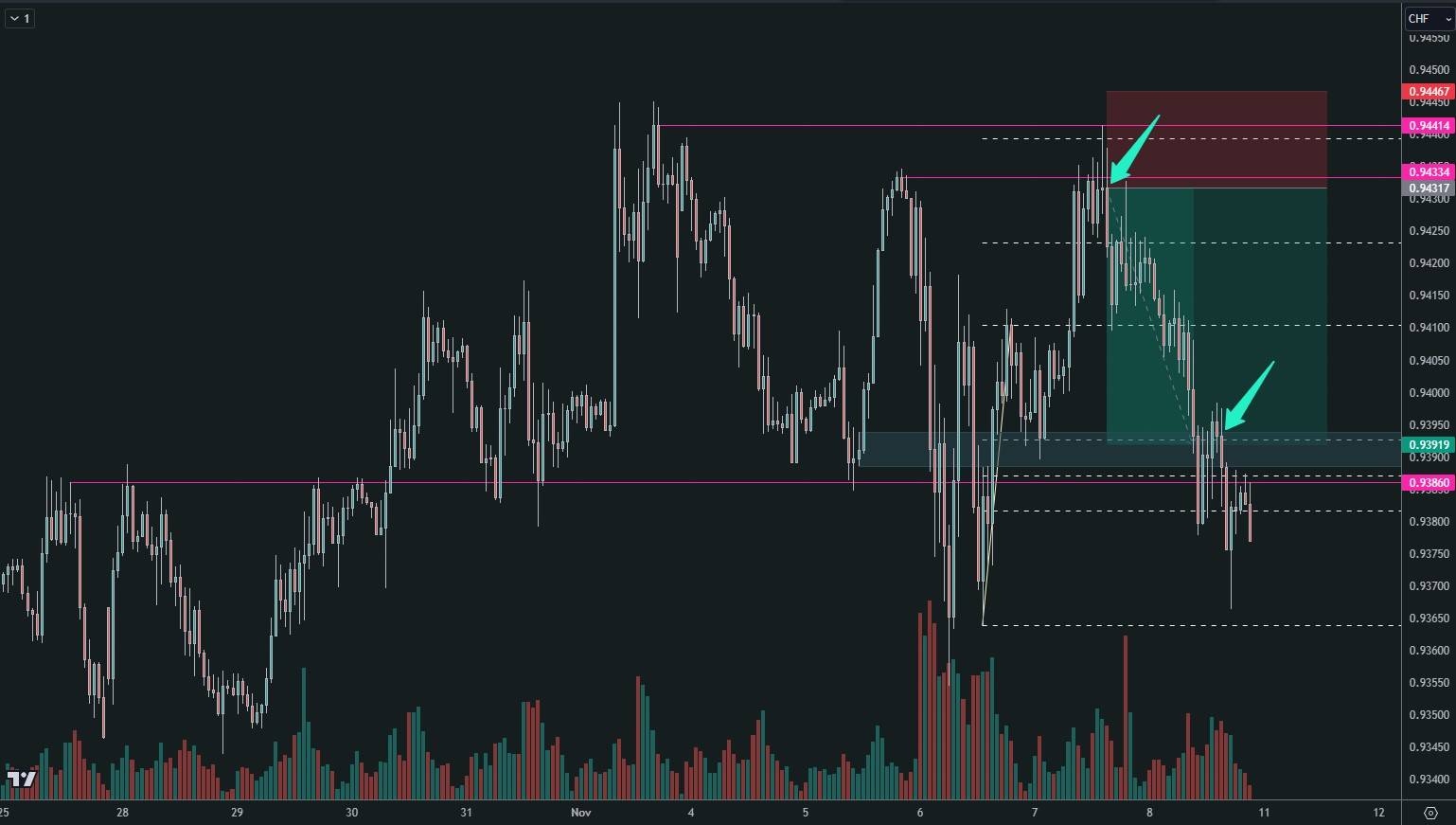
In most cases, I prefer to be out of trades before the weekend. Otherwise, there would have been a solid case to stay in this trade, at least partially.
If you’re not already a member and you want to follow my analysis and learn how to spot precise trades like this for yourself, check out the Duomo Trader Development Program.
How to Gain Trading Experience Quicker
If you’ve been trading for less than four years, last week might have been your first experience of the markets during a US election.
In recent years, we’ve seen several market-shaking events that traders encountered for the first time.
From the pandemic and Russia’s invasion of Ukraine to the banking crisis and the repo market meltdown-not to mention the usual market cycles, which have been unusually amplified.
Every time you go through one of these events, you gain valuable experience that helps you handle similarly disruptive situations in the future.
As a newer trader, you’re limited in what you’ve lived through. But there is a way to accelerate your learning curve: scenario training.
Here’s how to do it:
Step 1
Create a list of past market-disrupting events, such as market crashes, crises, natural disasters, wars, central bank actions, and cycles you haven’t experienced yet.
Step 2
For each event, plan realistic scenarios you might face: spotting new opportunities, managing losing positions, or navigating profitable ones.
Step 3
Schedule practice sessions for each scenario within each event. Be specific about what you aim to learn in each session and how you’ll take notes.
Step 4
Use a trading simulator to practise each scenario, setting it up to be as realistic as possible.
While a simulator can’t fully replicate live trading, it will give you valuable experience and insights you wouldn’t gain otherwise.
Quote of the Week
“There are two basic tools for dealing with complexity in analysis-decomposition and externalization.
Decomposition means breaking a problem down into its component parts. That is, indeed, the essence of analysis.
The spirit of decision analysis is to divide and conquer: Decompose a complex problem into simpler problems, get one’s thinking straight in these simpler problems, paste these analyses together with a logical glue
Externalization means getting the decomposed problem out of one’s head and down on paper or on a computer screen in some simplified form that shows the main variables, parameters, or elements of the problem and how they relate to each other.
Anything that has parts also has a structure that relates these parts to each other. One of the first steps in doing analysis is to determine an appropriate structure for the analytical problem, so that one can then identify the various parts and begin assembling information on them.”
— Richards Heuer
Most traders don’t start recording their analysis and conclusions until after a trade, when they update their journals. And it’s at that point they often spot the flaws.
By decomposing and externalising your analysis before or during the trade, rather than afterward, you can catch those blind spots and biases in real-time, not in hindsight.
Keeping everything in your head during a trade is a habit that leads to missed insights and risks-making it much harder to spot early warning signs or logical gaps.
Without a Trading Plan, the Markets Will Feel Manic
Our experience of time shifts depending on how much control we feel over a situation and how familiar it is.
When an environment feels familiar and we have a sense of control, time feels slower. But if we’re in an unfamiliar situation with less control, time seems to speed up.
This is especially true in the markets. Our level of planning will alter our perception of time.
If we don’t have our trade planned fully and we’re frantically searching for an entry or searching for clues on what to do next, the markets will feel very fast and the whole situation will feel manic.
On the other hand, when we have a well thought out plan, everything feels calmer. We don’t feel rushed, and our decisions are clearer and more focused.
High-quality thinking is always our goal in trading. That’s why I set a rule: before I make any decision in the market, I must know exactly where my next decision point will be.
The Trading Life Is Tough, But You’re Not Alone (Video)
In case you missed it, this week I recorded a video discussing the realities of trading. I also shared my own tough experiences.
The response to the video has been amazing. When you check it out, it’s definitely worth reading through the comments too.
Free Training Series
Start the free training.
Get free access to our 5-part training series. It covers the foundations of the Duomo approach, how to analyse markets logically, and the skills serious traders need to develop.